
Sacred Evolution: Bridging Science and Faith
“Could the Secrets of Our Evolution Be Written in Sacred Texts?”
No Conflict, No Compromise—Just a Powerful New Way of Thinking.
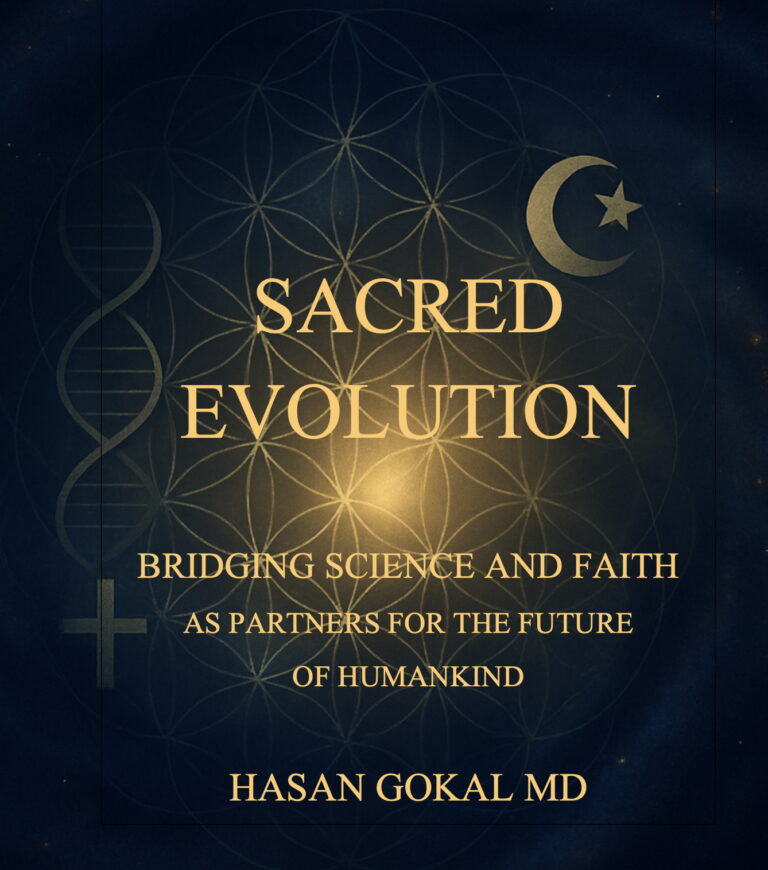
The Story of Sacred Evolution
In Sacred Evolution, Hasan Gokal, MD, introduces a groundbreaking perspective bridging science, spirituality, and ethics to offer a compelling path forward for humanity. Amid longstanding tensions between religious beliefs and scientific discoveries, Gokal eloquently argues for their compatibility, asserting that faith and empirical truth together guide our moral evolution. Drawing on insights from Christianity, Islam, and contemporary scientific thought, this innovative framework highlights how ethical virtues such as compassion, justice, and forgiveness are not merely spiritual ideals, but evolutionary necessities. Sacred Evolution challenges readers to reimagine faith as an active force that aligns with scientific realities, fostering individual growth and collective resilience. Deeply insightful yet accessible, the book encourages interfaith dialogue, provides clarity on complex ethical dilemmas, and empowers readers to transform their understanding of spirituality’s role in our evolving world, ultimately calling us to nurture a society defined by unity, moral courage, and scientific awareness.
“Just as the universe evolved spontaneously from simplicity to complexity, beginning with basic atomic interactions and culminating in intricate biological systems, human societies similarly evolved from basic survival-based interactions to sophisticated ethical and cooperative systems. From examining the past, it is reasonable to presume that humans may evolve further into yet unrecognizable forms. Going forward, humans of today may not even recognize the greater organism we will comprise, just as a single cell would not recognize the larger organism of which it is part. This is where religion enters the discussion. Moral and spiritual teachings found in religious traditions can be seen as evolutionary nudges designed to facilitate humanity’s growth toward advanced collective intelligence, social harmony, emotional resilience, ecological responsibility, and spiritual insight—critical characteristics for ensuring humanity’s sustainable future.”
Epigenetics and What We Pass On
Epigenetics reminds us that our genes do not operate in isolation. Nutrition, stress, toxins, and the conditions of early development can influence the way some genes are regulated, sometimes for decades. But does that mean our experiences routinely become biological instructions passed to unexposed grandchildren? The science is more cautious—and, to me, still remarkable.
In this essay, I look at what the evidence shows, what remains unsettled, and why the moral argument at the heart of Sacred Evolution does not depend on turning possibility into fact. Even if goodness is never found in a single gene or epigenetic switch, it is already carried forward through families, culture, institutions, and the examples we leave behind.